
DEXA Bone Density Scan Westchester
Gain a clearer picture of your bone health to address risks before they lead to weakness or injury
Detect Risks Early with Precision Bone Testing
At Maze Medical Fitness Testing (MMFT), our DEXA bone density scan and trabecular bone score (TBS) test measure both the density and quality of your bones. Standard bone scans like DEXA alone only measure density, but with TBS, we go deeper, analyzing the internal structure and strength of your bones. This advanced testing helps us detect risks for osteoporosis and fractures earlier, personalize prevention strategies, and monitor bone health over time.
What Is DEXA Bone Density and TBS Testing?
- A DEXA bone density scan measures bone mineral density (BMD) at key sites such as the spine, hips, and whole body. It helps identify osteopenia or osteoporosis.
- TBS goes beyond density, analyzing bone microarchitecture. Even if density looks fine, TBS can reveal fragile, porous bone structure that increases fracture risk.
Together, these tests provide the most comprehensive and clinically validated assessment of bone health available.

Why Bone Density and TBS Matter
- Prevent Osteoporosis: Detect early bone weakness before a fracture happens
- Protect Longevity: Poor bone quality raises fracture risk, which can shorten health span and independence
- Personalize Treatment: Guide decisions on resistance training, supplements, nutrition, and hormone therapy
- Track Changes over Time: Monitor if bones are getting stronger, not just denser
Who Should Get a DEXA Bone Density Scan and TBS Testing?

- Women over 40, especially post-menopausal
- Men over 50 or those with fracture/fall risk
- Patients with family history of osteoporosis
- Individuals with thyroid disorders, vitamin D deficiency, or hormonal changes
- Athletes or active adults tracking bone strength for longevity
What to Expect at Your Appointment
- Step 1 — Intake & Consultation (5–10 min): Review history, risk factors, and goals
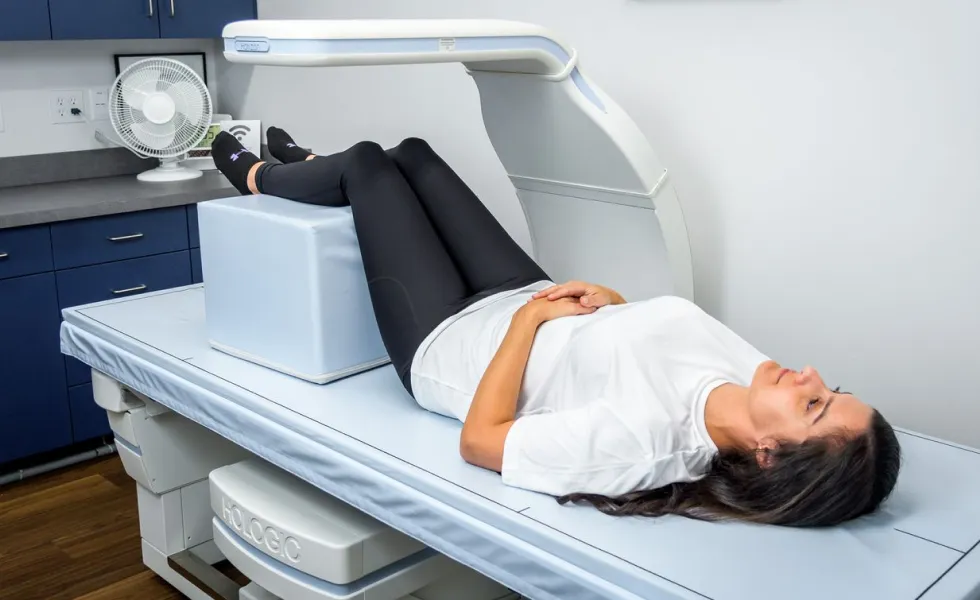
- Step 2 — DEXA Scan (10–15 min): Comfortable, noninvasive scan with extremely low radiation exposure
- Step 3 — Immediate Summary (5–10 min): Preliminary density and quality review
- Step 4 — Full Report (within 3 business days): Physician-reviewed analysis including BMD, TBS, and personalized bone health recommendations

What You’ll Learn
- Bone mineral density (spine, hip, whole body)
- Trabecular bone score (microarchitecture and strength)
- Combined fracture risk assessment
- Impact of muscle and fat (from DEXA body composition) on bone health
- Personalized prevention and treatment strategies
How Bone Density and TBS Complement Other Tests
| Test | What It Tells You | What Bone Density + TBS Adds |
|---|---|---|
| DEXA Body Composition | Fat vs. muscle mass | Whether lean tissue is protecting bone strength |
| VO₂ Max | Cardiovascular fitness | How bone health affects safe exercise intensity |
| RMR | Metabolism and calorie burn | Links between muscle, metabolism, and skeletal support |
| Bloodwork | Hormones, vitamin D, calcium | Confirms why bone density/structure may be low |
We focus exclusively on testing that has been shown to matter for long-term health. Every assessment we offer is supported by research linking the data to meaningful outcomes such as disease risk, functional capacity, and health span over time. Below, we highlight the studies we believe best explain and prove why each test is important to understanding your health.
Studies
Meta-analysis: excess mortality after hip fracture among older women and men
This study looked at older adults who broke a hip and found that their risk of dying is much higher [...]
A Meta-Analysis of Trabecular Bone Score in Fracture Risk Prediction and Its Relationship to FRAX
The objective of this meta-analysis was to determine whether TBS predicted fracture risk independently of FRAX probability and to examine [...]
Skeletal Muscle Mass as a Mortality Predictor among Nonagenarians and Centenarians: A Prospective Cohort Study
A large prospective cohort study of more than 700 adults aged 90 years and older found that skeletal muscle mass [...]
Low skeletal muscle mass index and all-cause mortality risk in adults: A systematic review and meta-analysis of prospective cohort studies
Low SMI was significantly associated with the increased risk of all-cause mortality, and the risk of all-cause mortality associated with [...]
FAQs: Bone Density and TBS Testing
How is TBS different from bone density?
Bone density measures the quantity of bone. TBS measures quality or the strength of the internal bone structure.
My doctor said my bone density was “normal.” Do I still need TBS?
Yes. TBS can reveal hidden fragility even if density is normal, allowing for earlier prevention.