
There are a lot of health numbers out there. Cholesterol. Blood pressure. Body fat percentage. Steps per day.
But if you could only know one number about your health, the one that best predicts how long and how well you’ll live, the science points to a single answer: your VO2 max.
And yes, you can actually measure it. At Maze Medical Fitness Testing, we do exactly that.
Okay, So What Is VO2 Max?
VO2 max is the maximum amount of oxygen your body can use during intense exercise. Think of it as your body’s engine size, how efficiently your heart, lungs, blood, and muscles work together to deliver oxygen and turn it into energy.
It’s measured in milliliters of oxygen per kilogram of body weight per minute (mL/kg/min). Higher number = bigger engine = more capacity for everything from climbing stairs to hiking a mountain to recovering from illness.
What makes VO2 max special is that it’s not just a fitness stat. It’s an integrated measure of how well your cardiovascular, pulmonary, hematologic, and musculoskeletal systems are working, all in one number.
Why It’s the Best Longevity Metric We Have
This isn’t wellness-influencer hype. The data is genuinely striking.
The 46-year study. Researchers followed 5,107 middle-aged men for nearly five decades. Those in the highest fitness category lived about 5 years longer than those in the lowest, even after adjusting for smoking, blood pressure, cholesterol, and other risk factors. Every single point of VO2 max improvement was associated with roughly 45 extra days of life.
The mega-analysis. A 2024 review pooling over 20.9 million observations from 199 cohort studies found that high fitness versus low fitness was associated with a 53% lower risk of death from any cause. Every 1-MET improvement in fitness (roughly 3.5 mL/kg/min) was linked to an 11–17% drop in mortality risk. It was also the strongest predictor of avoiding heart failure, a 69% risk reduction between high and low fitness.
No upper limit. A study of over 750,000 veterans found that mortality risk kept dropping as fitness climbed — with no point of diminishing returns. The fittest individuals lived about 6 years longer than the least fit.
It beats the usual suspects. Low cardiorespiratory fitness predicts all-cause mortality, cardiovascular events, and cancer death independently of, and often more strongly than, traditional risk factors like cholesterol and blood pressure.
Translation: your VO2 max may tell you more about your future than your lab work does.
Your Doctor’s Association Agrees
This isn’t fringe science. The American Heart Association issued a scientific statement making the case that cardiorespiratory fitness should be treated as a clinical vital sign, measured and tracked just like blood pressure and heart rate.
Their point: we routinely measure things that are far less predictive. Fitness deserves a spot on the chart.
How Is It Actually Measured?
Here’s where things get interesting, and where accuracy matters.
Your smartwatch gives you a VO2 max “estimate.” It’s a guess, based on your resting heart rate, age, and activity patterns. Research shows those resting-based estimates can be off by a wide margin, typically overestimating your true number.
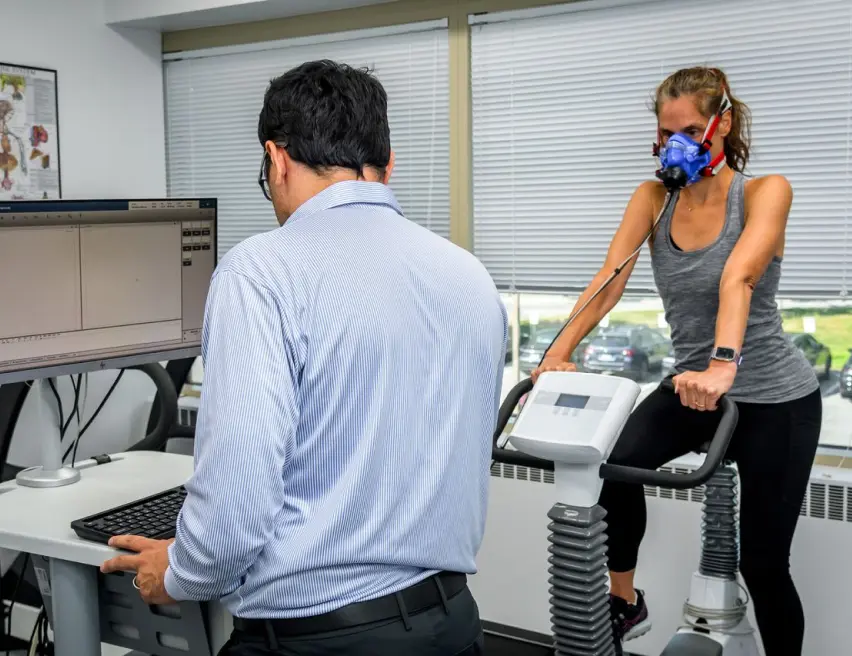
The gold standard is cardiopulmonary exercise testing (CPET) a real, direct measurement. You wear a mask that analyzes the oxygen you breathe in and the carbon dioxide you breathe out, while walking or cycling at gradually increasing intensity. The test measures your actual gas exchange rather than guessing at it.
It takes about 10–15 minutes of actual exercise. It’s challenging by design, you’re going to your max, but it’s safe, supervised, and over quickly.
And it gives you far more than one number: ventilatory efficiency, anaerobic threshold, heart rate response, and a clear picture of what’s limiting your performance.
What’s a “Good” VO2 Max?
It depends on age and sex, but here’s useful context from the research:
Advanced heart failure patients: under 10 mL/kg/min
Average sedentary adult: roughly 25–35 mL/kg/min
Fit and active adults: roughly 40–50 mL/kg/min
Elite endurance athletes: 80+ mL/kg/min
More useful than the raw number is where you rank for your age and sex, and how much fitness you need for meaningful protection. Research suggests that to achieve roughly a 50% reduction in mortality risk, you’d want about 11 METs if you’re 30–49, 10 METs at 50–59, 8 METs at 60–79, and 7 METs at 80+.
The Best News: This Number Is Changeable
Cholesterol is partly genetic. Age is fixed. But VO2 max responds dramatically to training, and the people with the most to gain are the ones starting from the lowest baseline.
The biggest mortality benefit occurs in the jump from least fit to next-least fit. You don’t have to become an athlete. You just have to stop being sedentary.
What moves the needle:
Zone 2 cardio — steady, conversational-pace aerobic work, 3–4 sessions per week
High-intensity intervals — short, hard efforts once or twice a week
Consistency over intensity — the research favors regular training over heroic occasional efforts
Retesting — measure, train, remeasure. Improvements in fitness over time are themselves associated with lower mortality
Where Maze Medical Fitness Testing Comes In
At Maze Medical Fitness Testing, we offer true VO2 max testing, not a watch estimate, but a real, direct measurement using metabolic gas analysis.
Here’s what you walk away with:
Your actual VO2 max number, and how you rank for your age and sex
Personalized heart rate training zones so you know exactly how hard to work
Your metabolic and ventilatory thresholds, where your body shifts gears
A clear baseline to track your progress over time
Pair it with a DEXA body composition scan, also available at Maze Medical Fitness Testing, and you have a genuinely complete picture: your engine size, your muscle mass, your body fat, and your bone density.
Who Should Get Tested?
Honestly? Almost anyone. But especially:
Anyone serious about longevity and healthspan
Athletes and weekend warriors who want precise training zones
People starting a fitness program who want a real baseline
Adults over 40 who want an objective read on cardiovascular health
Anyone who’s been training hard and wants to know if it’s actually working
The Bottom Line
Your VO2 max is the closest thing we have to a single number that predicts how long, and how well, you’ll live. It’s backed by decades of data across millions of people. It’s recommended as a vital sign by the American Heart Association. And unlike your age or your genetics, it’s a number you can change.
But you can’t improve what you don’t measure.
Book your VO2 Max test at Maze Medical Fitness Testing today!
References
Ross R, Blair SN, Arena R, et al. Importance of Assessing Cardiorespiratory Fitness in Clinical Practice: A Case for Fitness as a Clinical Vital Sign. Circulation (American Heart Association Scientific Statement), 2016.
Clausen JSR, Marott JL, Holtermann A, et al. Midlife Cardiorespiratory Fitness and the Long-Term Risk of Mortality: 46 Years of Follow-Up. Journal of the American College of Cardiology, 2018.
Lang JJ, Prince SA, Merucci K, et al. Cardiorespiratory Fitness Is a Strong and Consistent Predictor of Morbidity and Mortality Among Adults. British Journal of Sports Medicine, 2024.
Kokkinos P, Faselis C, Samuel IBH, et al. Cardiorespiratory Fitness and Mortality Risk Across the Spectra of Age, Race, and Sex. Journal of the American College of Cardiology, 2022.
Petek BJ, Al-Alusi MA, Moulson N, et al. Consumer Wearable Health and Fitness Technology in Cardiovascular Medicine: JACC State-of-the-Art Review. Journal of the American College of Cardiology, 2023.