
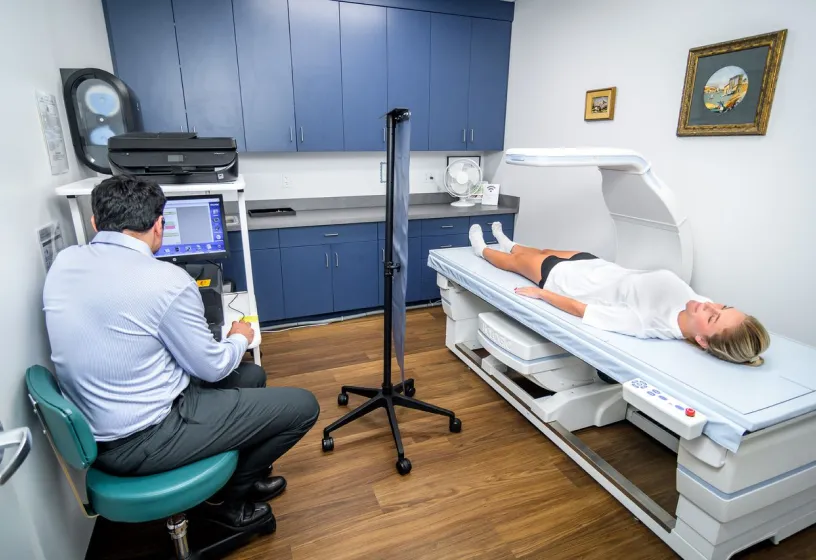
Two technologies dominate the body composition testing landscape: InBody bioelectrical impedance analysis (BIA) and DEXA (Dual-Energy X-ray Absorptiometry) scans. Both claim to reveal your body’s true composition.
What They Actually Measure
InBody:
InBody uses bioelectrical impedance analysis, sending a safe electrical current through your body. Muscle conducts electricity better than fat, so the device estimates body composition based on resistance patterns. Stand on the device, hold the electrodes, get results in 60 seconds.
What you get
Body fat percentage, skeletal muscle mass, visceral fat level, body water distribution, and segmental lean analysis for each limb.
DEXA:
DEXA uses dual-energy X-ray absorptiometry, the same technology developed for bone density assessment. Two X-ray beams pass through your body, differentiating between bone mineral, lean tissue, and fat tissue with extraordinary precision. Lie on a table for 5-7 minutes and get the most accurate body composition data available.
What you get
Total and regional body fat, lean muscle mass, bone mineral density, visceral adipose tissue, android/gynoid fat distribution, and appendicular lean mass.
The Accuracy Gap: Why It Matters
DEXA is the clinical gold standard with a margin of error of approximately 1-2% for body fat percentage [1]. It directly images tissues rather than estimating them.
InBody is remarkably good for a BIA device, accurate within 2-4% of DEXA values under ideal conditions [2]. But several factors throw off InBody readings significantly.
- Hydration status (the biggest variable)
- Recent food intake
- Exercise timing
- Skin temperature
- Electrolyte balance
- Menstrual cycle phase
DEXA readings are largely unaffected by these variables. Hydration alone can swing InBody readings by 2-5 pounds of apparent lean mass [4], enough to completely misinterpret your progress.
The Smart Approach: Baseline with DEXA, Track with Smart Scales
Here’s what we recommend at Maze Medical Fitness Testing:
Start with a DEXA scan. Get your true baseline—accurate body composition, bone density, and visceral fat levels. This is your ground truth. Build your training and nutrition strategy on real data, not estimates.
Track trends with smart scales. Use InBody or any quality bioimpedance scale for weekly or biweekly monitoring. The absolute numbers matter less than the direction. Are you gaining muscle? Losing fat? Moving toward your goals?
Validate every 3-6 months with DEXA. This is non-negotiable. Come back for a DEXA scan to confirm that what you’re seeing on your smart scale actually reflects real changes in your body. This prevents wasting months on a program that looks effective on paper but isn’t delivering results.
Why this approach works: You get the frequency and convenience of affordable tracking with the accuracy and validation of clinical-grade testing. No guesswork, no wasted effort.
Suggested Approach
Month 0: Get a baseline DEXA scan. Know exactly where you’re starting: body composition, visceral fat, and bone density.
Months 1-6: Track weekly or biweekly with your InBody or smart scale. Control your testing conditions: same time of day, similar hydration state, consistent timing relative to meals and training.
Month 3 or 6: Return for a DEXA validation scan. Confirm your smart scale trends are accurate. Adjust your interpretation and recalibrate if needed.
Ongoing: Continue smart scale tracking between DEXA validations every 3-6 months.
This gives you continuous feedback without breaking the bank, backed by clinical-grade accuracy checks.
Ready to see what your body composition really looks like?
Visit Maze Medical Fitness Testing to book your DEXA scan and start tracking your progress with clinical-grade accuracy.
#MazeMedicalFitnessTesting #DEXAScan #BodyComposition #FitnessTesting #HealthData