
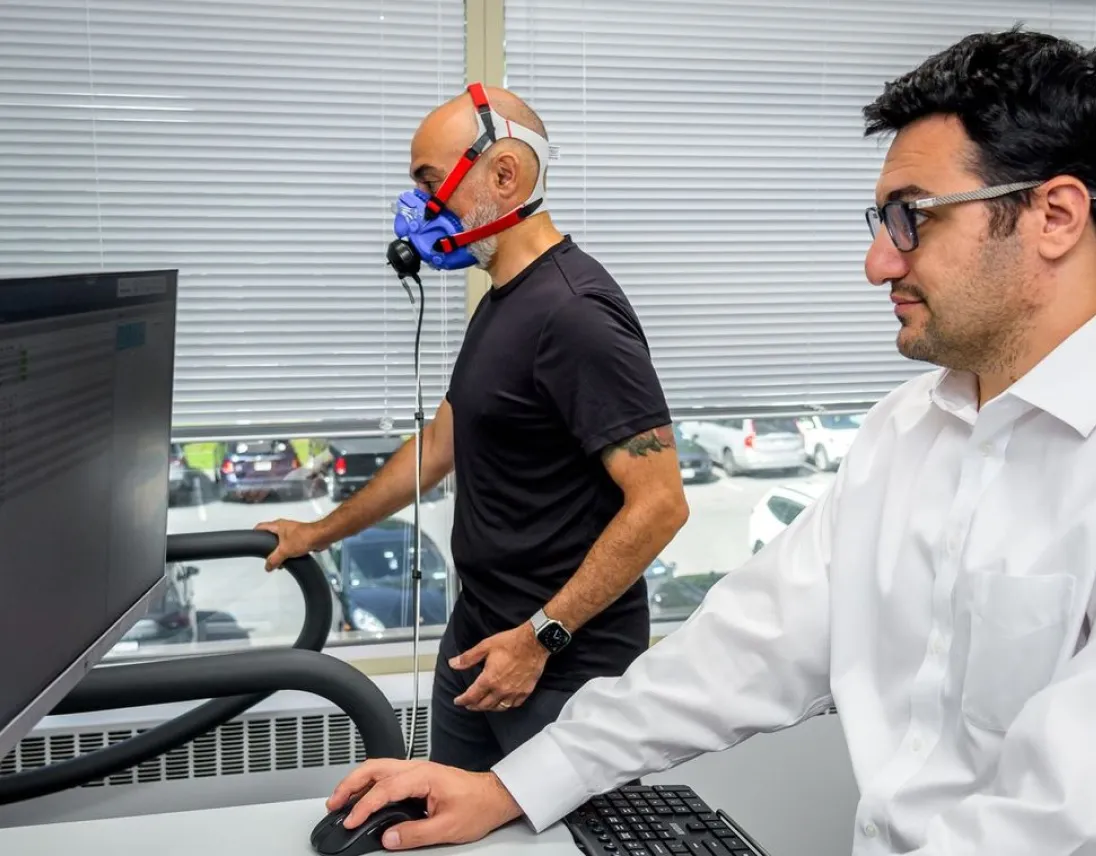
It’s Not Your Cholesterol. It’s Not Your Weight.
Most people have heard of cholesterol panels and blood pressure checks. However, there is a fitness metric that leading researchers are calling one of the most important vital signs that many people are not tracking: VO2 max.
VO2 max, your body’s maximum capacity to use oxygen during exercise, is no longer just for elite athletes. It is relevant for anyone who wants to understand and improve both the length and quality of their life.
What Exactly Is VO2 Max?
Think of VO2 max as your body’s engine size. It measures how efficiently your heart, lungs, and muscles work together during physical exertion. The higher your VO2 max, the more oxygen your body can deliver and use, resulting in greater cardiovascular resilience (Ross et al., 2016) [5].
VO2 max is measured in milliliters of oxygen per kilogram of body weight per minute (mL/kg/min). Although it naturally declines with age, it is highly trainable. Even modest improvements in cardiorespiratory fitness can produce meaningful health benefits (Kokkinos et al., 2022) [2].
“Cardiorespiratory fitness is arguably the most important vital sign we should be measuring. Nothing else predicts mortality risk as clearly.”
— Dr. Jari Laukkanen, University of Eastern Finland
The JAMA Study That Changed Everything
A landmark study published in JAMA Network Open followed more than 122,000 patients and found that low cardiorespiratory fitness was associated with a risk of death comparable to, and in some cases exceeding, that of traditional risk factors such as smoking, hypertension, and diabetes (Mandsager et al., 2018) [1].
Most notably, individuals with elite fitness levels demonstrated a mortality risk approximately five times lower than those categorized as having low fitness. Researchers found no apparent upper limit to the benefits of improved fitness, the fitter participants became, the longer they tended to live (Mandsager et al., 2018) [1].
Key Research Findings
JAMA Network Open (2018) [1]
In a cohort of more than 122,000 patients, low fitness levels were associated with mortality risks comparable to major chronic diseases. Elite-level VO2 max was linked to a fivefold reduction in all-cause mortality risk.
Journal of the American College of Cardiology (2022) [2]
Each 1-MET increase in cardiorespiratory fitness was associated with a 21% reduction in all-cause mortality, independent of age, sex, and body mass index.
Mayo Clinic Proceedings (2016) [3]
Higher fitness levels were associated with substantially lower risks of cardiovascular mortality compared to lower fitness levels.
Circulation (2015) [4]
Higher levels of cardiorespiratory fitness and physical activity were associated with healthier aging and reduced risk of cardiovascular disease outcomes.
Why It Is Not Just About Your Heart
Cardiovascular fitness affects much more than cardiovascular health. Research suggests that higher levels of cardiorespiratory fitness provide benefits throughout the body (Ross et al., 2016; Sui et al., 2007) [5, 6].
Health Benefits of Higher VO2 Max
- Reduced risk of type 2 diabetes and metabolic syndrome (Sui et al., 2007) [6]
- Lower levels of inflammation associated with cognitive decline and dementia (Hamer et al., 2018) [7]
- Improved lung function and breathing efficiency (Ross et al., 2016) [5]
- Enhanced oxygen delivery to muscles, organs, and the brain (Ross et al., 2016) [5]
- Faster recovery from illness, surgery, and physical stress (Kokkinos et al., 2022) [2]
The connection to longevity is clear: individuals with higher VO2 max values not only tend to live longer but also remain healthier, more independent, and cognitively sharper throughout later life (Hamer et al., 2018; Myers et al., 2002) [7, 8].
Why You Need to Actually Test It
Many people assume their fitness level is adequate based on how they feel during daily activities. However, cardiorespiratory fitness cannot be accurately estimated through subjective impressions alone. VO2 max requires objective measurement, and without testing, important information about health and performance may remain unknown (Myers et al., 2002) [8].
What a VO2 Max Test Can Tell You
A VO2 max assessment provides:
- Your precise cardiovascular fitness level and how it compares to age matched peers
- Your aerobic threshold, indicating when fat metabolism transitions toward greater carbohydrate utilization
- Personalized training zones for improving endurance and performance
- A measurable baseline for monitoring fitness progress over time
Without testing, fitness assessment is largely based on assumptions. With a VO2 max test, health and training decisions can be informed by objective data.
At Maze, We Make It Simple
At Maze Medical Fitness Testing, VO2 max assessments are physician supervised, clinically validated, and designed to provide a clear understanding of cardiovascular fitness and opportunities for improvement.
VO2 max testing can be combined with additional assessments, including:
- DEXA body composition analysis
- DEXA Bone Density Scan
- Resting metabolic rate testing
- Comprehensive bloodwork
Together, these evaluations provide a detailed, data-driven picture of overall health. Rather than relying on generalized wellness scores, clients receive a personalized roadmap for improving long-term health and performance.
The goal is not simply to live longer, it is to remain strong, healthy, independent, and thriving throughout life.
Sources
Mandsager et al., JAMA Network Open (2018)
Kokkinos et al., JACC (2022)
Laukkanen et al., Mayo Clinic Proceedings (2016)
Pandey et al., Circulation (2015)
Ross et al., Circulation (2016)
Sui et al., JAMA (2007)