
You track your weight. Maybe you know your cholesterol. You might even know your VO₂ max.
But do you know how strong your bones are?
Probably not.
That’s because bone loss usually doesn’t announce itself with obvious symptoms. You can feel healthy, stay active and exercise regularly while changes in bone density are happening quietly in the background.
Sometimes, the first clue is a fracture.
A DEXA bone density scan gives you the opportunity to look at bone health before that happens.
What Is a DEXA Bone Density Scan?
DEXA, also called DXA, stands for dual-energy X-ray absorptiometry.
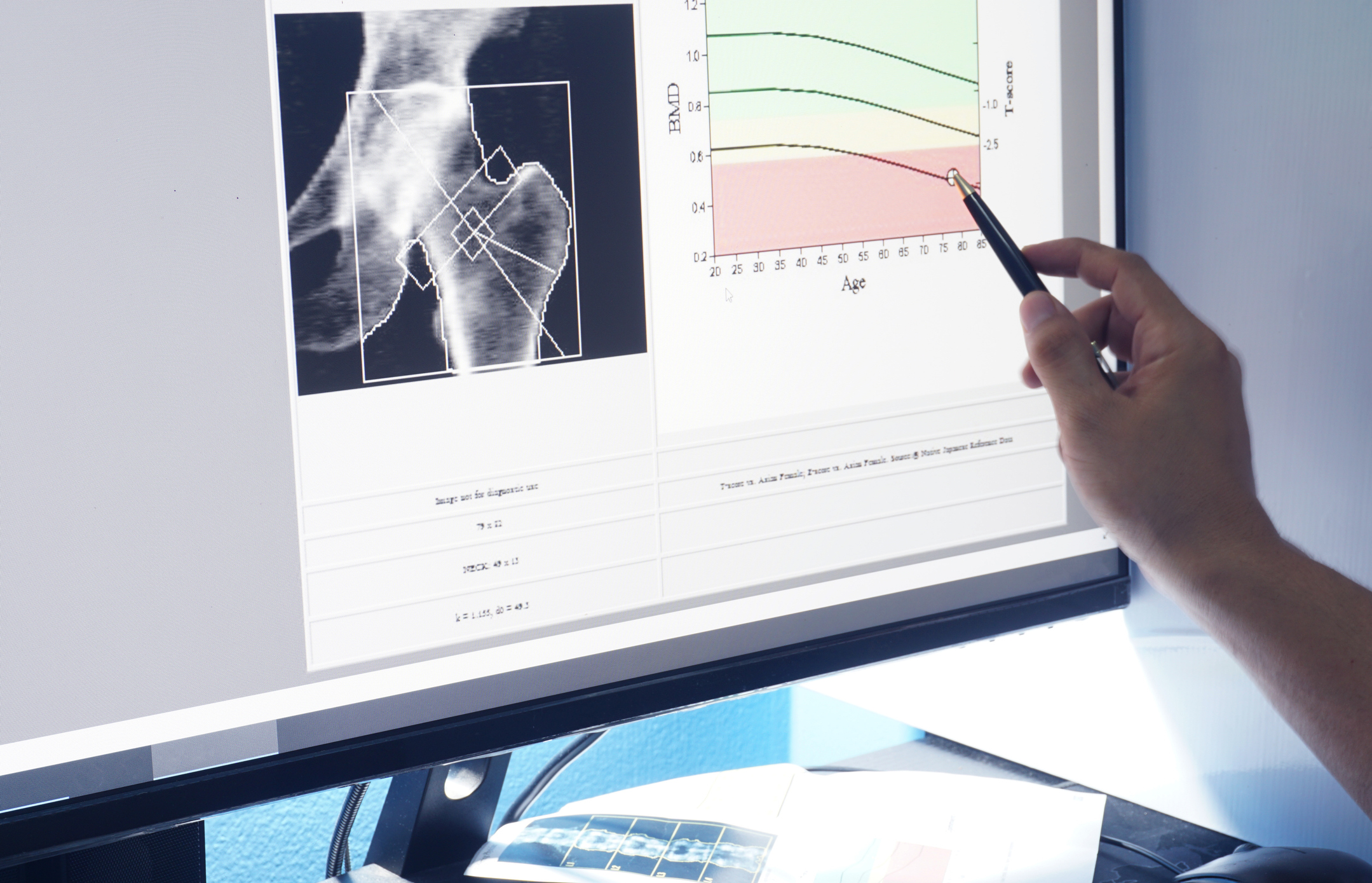
It’s a quick, noninvasive test that uses a very low dose of X-rays to measure bone mineral density (BMD), typically at areas such as the hip and spine.
DEXA testing can help identify osteopenia (low bone mass) and osteoporosis, estimate future fracture risk and monitor changes in bone density over time.
And unlike your bathroom scale or fitness tracker, this is information you can’t figure out simply by looking at yourself.
“But I Exercise. Aren’t My Bones Fine?”
Exercise, particularly resistance and weight-bearing exercise—is an important part of supporting bone health.
But being active doesn’t make you immune to bone loss.
Age, menopause, hormonal changes, family history, certain medical conditions, medications and other factors can influence bone health.
And here’s what makes this particularly tricky:
Low bone density doesn’t necessarily hurt.
You may not know there’s a problem until your bones are put to the test in a way you definitely didn’t want.
That’s one reason identifying risk earlier can be so valuable.
Bone Density Isn’t the Entire Story
This is where testing at Maze Medical Fitness Testing goes a step further.
Maze pairs its DEXA bone density scan with Trabecular Bone Score (TBS).
Think of it this way:
DEXA asks: How dense is the bone?
TBS asks: What does the internal structure of that bone look like?
TBS analyzes information related to the bone’s microarchitecture, adding another piece of information that can help with fracture-risk assessment.
So rather than looking at bone density in isolation, Maze can evaluate bone density and bone quality together.
Who Should Think About Bone Density Testing?
Bone density testing becomes increasingly important as we age.
Current U.S. Preventive Services Task Force recommendations call for osteoporosis screening with DEXA bone mineral density testing in women 65 and older, as well as postmenopausal women under 65 who are determined to be at increased risk. For men, the USPSTF currently says there isn’t enough evidence to recommend universal screening, so decisions should be individualized.
Other circumstances can also affect bone health, so your personal risk factors and medical history matter.
At Maze, bone density and TBS testing may be particularly relevant for people focused on healthy aging, maintaining strength and mobility, monitoring hormonal changes, or better understanding their long-term bone health.
Why Bone Health Belongs in the Longevity Conversation
“Longevity” gets thrown around a lot.
But living longer isn’t particularly appealing if you can’t continue doing the things you enjoy.
Strong bones help support mobility, physical activity and independence as you age. Osteoporotic fractures, particularly hip fractures, can have significant consequences for mobility and quality of life. The USPSTF notes that only about 40%–60% of people who experience a hip fracture recover their previous level of mobility and ability to perform daily activities.
That’s why bone health shouldn’t be an afterthought.
Building your healthspan isn’t only about your heart, muscles or metabolism. Your skeleton has to come along for the ride.
What Happens During a DEXA Bone Density Scan?
It’s much less intimidating than the name makes it sound.
At Maze Medical Fitness Testing, the DEXA scan itself typically takes about 10–15 minutes. It’s noninvasive and uses a very low level of radiation. Maze then provides a physician-reviewed report that includes bone mineral density, TBS and personalized insights based on the results.
No treadmill.
No needles.
No trying to beat your personal record.
You basically lie still while the technology does the work.
Don’t Wait Until Your Bones Get Your Attention
We test cholesterol before a heart attack.
We measure blood pressure before it becomes an emergency.
So why wait for a fracture to start thinking about bone health?
A DEXA bone density scan can help identify low bone density before osteoporosis progresses and provide objective information that can be used alongside your health history and other risk factors.
At Maze Medical Fitness Testing, DEXA bone density testing is combined with Trabecular Bone Score to provide a more complete look at bone density, structure and fracture risk.
Because healthy aging isn’t simply about adding years to your life.
It’s about staying strong enough to enjoy them.
Learn more about DEXA Bone Density + TBS Testing at Maze Medical Fitness Testing.