
Creatine is one of the most researched supplements on the planet, and one of the most talked about tools in the longevity and healthy aging conversation. Beyond its well-known role in building muscle and strength, a growing question keeps coming up: can creatine improve bone density in men and women?
The honest, evidence-based answer is nuanced. And it points to something even more important for your long-term health: the value of actually measuring your bone density with a DEXA (DXA) bone density scan rather than guessing. Here is what the science says, and how comprehensive testing at Maze Medical Fitness Testing fits into a smarter longevity strategy.
Why Bone Density Matters for Longevity
Bone loss is a silent process. It accelerates with age in both sexes, dramatically so in women after menopause, and low bone mineral density (BMD) is a major driver of fragility fractures. A hip or spine fracture later in life is not just painful; it is strongly linked to loss of independence, reduced quality of life, and increased mortality.
That is why protecting your skeleton is a cornerstone of any serious longevity plan. And it is why you cannot manage what you do not measure.
Creatine and Bone Density: What the Research Actually Shows
Creatine, especially creatine monohydrate, has long been proposed as a low-cost, safe way to support aging muscle and bone (Candow et al., Bone, 2022). The theory is appealing, but the high quality trial data are more sobering than the supplement marketing suggests.
In postmenopausal women, creatine alone did not increase bone mineral density. A rigorous two year randomized controlled trial of 237 postmenopausal women found that creatine combined with resistance training and walking had no effect on bone mineral density at the femoral neck, total hip, or lumbar spine compared with placebo. However, creatine did help maintain certain geometric properties of the hip bone (section modulus and buckling ratio) that relate to bone bending strength, a potentially meaningful, though secondary, benefit (Chilibeck et al., Medicine & Science in Sports & Exercise, 2023).
Similarly, a separate two year randomized trial in older postmenopausal women with osteopenia found that 3 g/day of creatine did not improve bone mineral density, bone microarchitecture, or reduce falls and fractures, leading the authors to caution against the long-held assumption that creatine has stand alone bone building properties (Sales et al., Journals of Gerontology: Series A, 2020).
There may be sex specific and site-specific nuances. In a one year study of older men and women doing resistance training, creatine helped increase or maintain total bone area at the tibia, with men in particular showing gains in trabecular and cortical bone area (Candow et al., Medicine & Science in Sports & Exercise, 2021). This hints that creatine’s skeletal effects may differ between men and women and by bone site, but the evidence is still preliminary.
The consistent takeaway: creatine is not a magic bullet for bone density, and it works best as a companion to resistance training, not a replacement for it (Candow et al., Bone, 2022). Its clearest, most reliable benefits remain in the muscle domain, lean mass, strength, and physical function, which indirectly support bone health by reducing falls.
The Bottom Line on Creatine for Men and Women
- Creatine is safe, affordable, and well-tolerated in the studied doses.
- It should be paired with resistance training to have any meaningful musculoskeletal impact.
- It is not a substitute for proven bone-health strategies: strength training, adequate protein, vitamin D and calcium, and medical treatment when indicated.
- Most importantly, whether or not you take creatine, you need to know your actual bone density to make informed decisions.
Why a DEXA (DXA) Bone Density Scan Is the Smartest Next Step
Here is the point supplements can’t address: you cannot feel your bone density. The only way to know where you stand is to measure it.
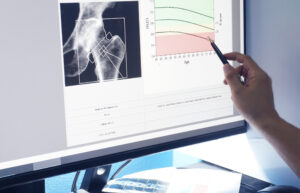
DXA (dual-energy X-ray absorptiometry) is the gold standard for measuring bone mineral density. It uses a very low dose of radiation, correlates with bone strength and fracture risk, and is the test used to diagnose osteopenia and osteoporosis and to guide treatment decisions. The U.S. Preventive Services Task Force recommends bone density screening to prevent osteoporotic fractures, and DXA remains underutilized despite its proven value (USPSTF, JAMA, 2025).
A DEXA scan gives you:
- Your T-score and Z-score, classifying your bone health as normal, osteopenia, or osteoporosis
- A baseline to track whether your training, nutrition, and supplement strategy (including creatine) are actually working over time
- Early warning that allows you to intervene years before a fracture happens
- In many cases, body composition data, precise measurement of lean mass and fat mass, that complements your longevity and fitness goals
If you are investing in creatine, strength training, and healthy aging, a DEXA scan is how you confirm your strategy is protecting the one system you can’t rebuild easily: your skeleton.
How Maze Medical Fitness Testing Supports Your Longevity Goals
At Maze Medical Fitness Testing, we believe in data-driven health. Guessing is not a strategy — measuring is. Our comprehensive testing services are designed to give you the objective numbers you need to optimize performance, prevent disease, and add healthy years to your life.
Whether you want to establish a bone density baseline, track your body composition, or build a complete picture of your metabolic and cardiovascular health, our team can help you turn testing into an actionable longevity plan.
Ready to know your numbers? Schedule your DEXA bone density scan with Maze Medical Fitness Testing today.
Curious about the bigger picture of healthy aging? Explore our full menu of longevity and performance testing services, and see how Maze Health can support you at every stage of your journey.
Book a comprehensive fitness and longevity assessment with Maze Medical Fitness Testing.
sources
Chilibeck PD, Candow DG, Gordon JJ, et al. A 2-Yr Randomized Controlled Trial on Creatine Supplementation During Exercise for Postmenopausal Bone Health. Medicine & Science in Sports & Exercise. 2023. [1]
Sales LP, Pinto AJ, Rodrigues SF, et al. Creatine Supplementation (3 g/d) and Bone Health in Older Women: A 2-Year, Randomized, Placebo-Controlled Trial. The Journals of Gerontology: Series A, Biological Sciences and Medical Sciences. 2020. [2]
Candow DG, Chilibeck PD, Gordon JJ, Kontulainen S. Efficacy of Creatine Supplementation and Resistance Training on Area and Density of Bone and Muscle in Older Adults. Medicine & Science in Sports & Exercise. 2021. [3]
Candow DG, Chilibeck PD, Forbes SC, et al. Creatine Supplementation for Older Adults: Focus on Sarcopenia, Osteoporosis, Frailty and Cachexia. Bone. 2022. [4]
US Preventive Services Task Force, Nicholson WK, Silverstein M, et al. Screening for Osteoporosis to Prevent Fractures: US Preventive Services Task Force Recommendation Statement. JAMA. 2025.